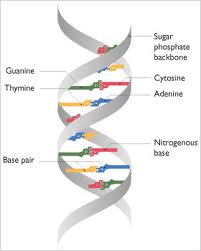
STRUCTURE OF DNA: The double helix model allows the two strands of DNA to run in opposite directions (antiparallel). This allows the nitrogenous bases on each strand to come into contact at the center of the molecule. This also allows each strand to carry a sequence of nucleotides. In DNA the double helix is held together by hydrogen bonds that form between certain nitrogenous bases. Hydrogen bonds are weak forces, which is good because this allows the two strands to be separated which is important to DNA's functions of storing, copying, and transmitting the genetic information in a cell. The two strands are held together by hydrogen bonds between the nitrogenous bases: adenine and thymine, and guanine and cytosine. This is known as base pairing. |
 |
|
HOW HARD WORK HELPED TO DETERMINE THE STRUCTURE OF DNA: ERWIN CHARGAFF: Chargaff (Austrian-American biochemist) discovered the percentages of A (adenine), T (thymine) are almost always equal in any sample of DNA. He also saw that this was true of the other two nucleotides G (guanine), and C (cytosine). He found A=T and G=C (Chargaff 's rule) and that this was true in all organisms. ROSALIND FRANKLIN: Franklin (British scientist) used X-ray diffraction to find her information. She found that DNA's X-shaped pattern shows that the strands are twisted, like the coils of a spring, a shape known as a helix. The angle of X-shape showed that there were two strands. Other clues showed that the nitrogenous bases are near the middle of the DNA molecule. WATSON AND CRICK: Watson (American biologist) and Crick (British physicist) built a model that explained the specific structure and properties of DNA, from Franklins X-ray pattern. They helped set a picture of the double helix form by creating a model. 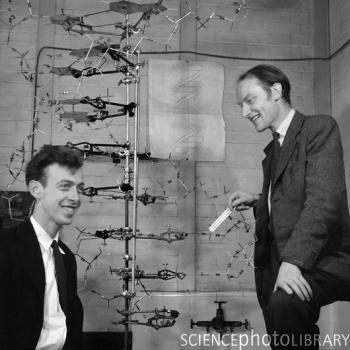 |
||
