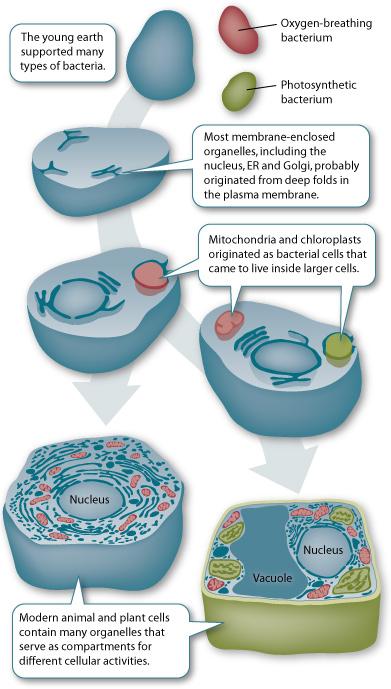
The Endosymbiotic Theory: This theory describes evidence that mitochondrias and chloroplasts were once bacterial cells. Symbiosis is when two different species benefit from living and working together. Then when one organism lives inside another it is known as endosymbiosis. This theory describes how a large host cell and ingested bacteria may have become dependent on one another for life, resulting in a relationship. Evolution over millions of years has resulted in the mitochondrias and chloroplasts becoming more specialized and leading to today, not being able to live outside the cell. There is compelling evidence to this theory. Mitochondrias and chloroplasts are very similar to bacterial cells. They have their own DNA, which is separate from the DNA in the nucleus of the cell. Proteins and enzymes used for their functions are produced by each organelle using their DNA. Each being ingested by a host proves why each organelle has a double membrane. The two organelles also reproduce like bacteria, by directing their own division and replicating their own DNA.
|
 |
