TRANSCRIPTION: Transcription uses pieces of DNA to act as templates to make RNA molecules. Transcription is where the mRNA copies the DNA, which makes it possible for the DNA (inside mRNA) to leave the nucleus and enter the cytoplasm. 1. RNA polymerase binds to DNA and separates the strands. 2. Uses a strand of DNA as a template to assemble nucleotides into a strand of RNA. *To copy a DNA strand into RNA makes it possible for a gene to produce hundreds or thousands of RNA molecules. ANALOGY: Transcription is like when a child wants to go shopping at a store. Their parents won't let them leave the house to walk there because it's too dangerous. So the parent ends up taking the child in their car to the store. This is like the DNA leaving the nucleus; it is too dangerous to leave because it could be damaged. So the messenger RNA copies the DNA so they can transport it outside of the nucleus. 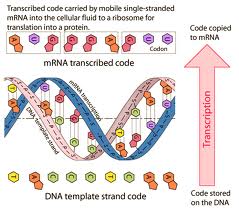 Protein synthesis Protein synthesis starts off in the nucleus of a cell. The entire sequence of nucleotides that provides organisms with all of the information needed to live and grow is the DNA of a cell. Because it has such an important role, it cannot directly leave the nucleus, for fear that it will be damaged. So the DNA is transcribed into an mRNA strand. This strand then leaves the cell into the cytoplasm where it locates a ribosome. After this the mRNA strand is then translated into an amino acid chain, which then can determine different traits.
DNA SEQUENCE: CAT GTG GAG TGG GGA CTC CTC TTT AGT CGA CAT TGC TRANSCRIBED: GUA CAC CUC ACC CCU GAG GAG AAA UCA GCU GUA ACG TRANSLATED: GUA= Valine, CAC= Histidine, CUC= Leucine, ACC= Threonine, CCU= Proline, GAG= Glutamic acid, GAG= Glutamic acid, AAA= Lysine, UCA= Serine, GCU= Alanine, GUA= Valine, ACG= Threonine. |
TRANSLATION: Translation is the process where a mRNA message is decoded into a protein. 1. Messenger RNA is transcribed in the nucleus and then enters the cytoplasm. 2. Transfer RNA- Translation begins at AUG, the start codon. The ribosome positions the start codon to attract its anticodon. The ribosome also binds the next codon and its anticodon. 3. The polypeptide "Assembly line"- The ribosome joins the two amino acids (methionine and phenylalanine) and breaks the bond between methionine and its tRNA. This tRNA then floats away from the ribosome which allows the ribosome to bind another tRNA. The ribosome moves along the mRNA, right to left, binding new tRNA molecules and amino acids. 4. Completing the polypeptide- The ribosome reaches one of the three stop codons. When the polypeptide is complete, it and the mRNA are released from the ribosome completing the process of translation. ANALOGY: If you have instructions to assemble a toy, it won't be enough. You need to read them and then put the parts together. Ribosomes carry out this task and translation occurs once this mRNA message is decoded into amino acids (proteins) by protein synthesis.
VIDEO: 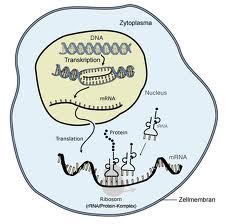 |

